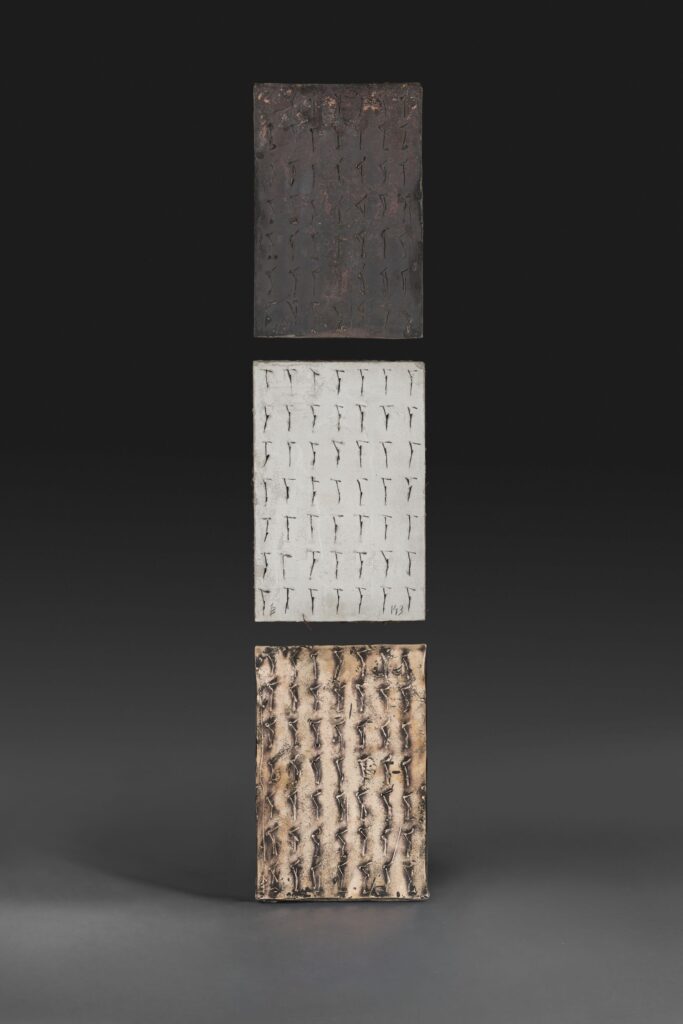
In 1962, Picelj initiated a series of his self-published “Edition a” art booklets, having released a total of seven publications up until 1964. Each issue of “Edition a” featured the work of one artist —mostly of a colleague whose work he admired.

In 1962, Picelj initiated a series of his self-published “Edition a” art booklets, having released a total of seven publications up until 1964. Each issue of “Edition a” featured the work of one artist —mostly of a colleague whose work he admired.
2026
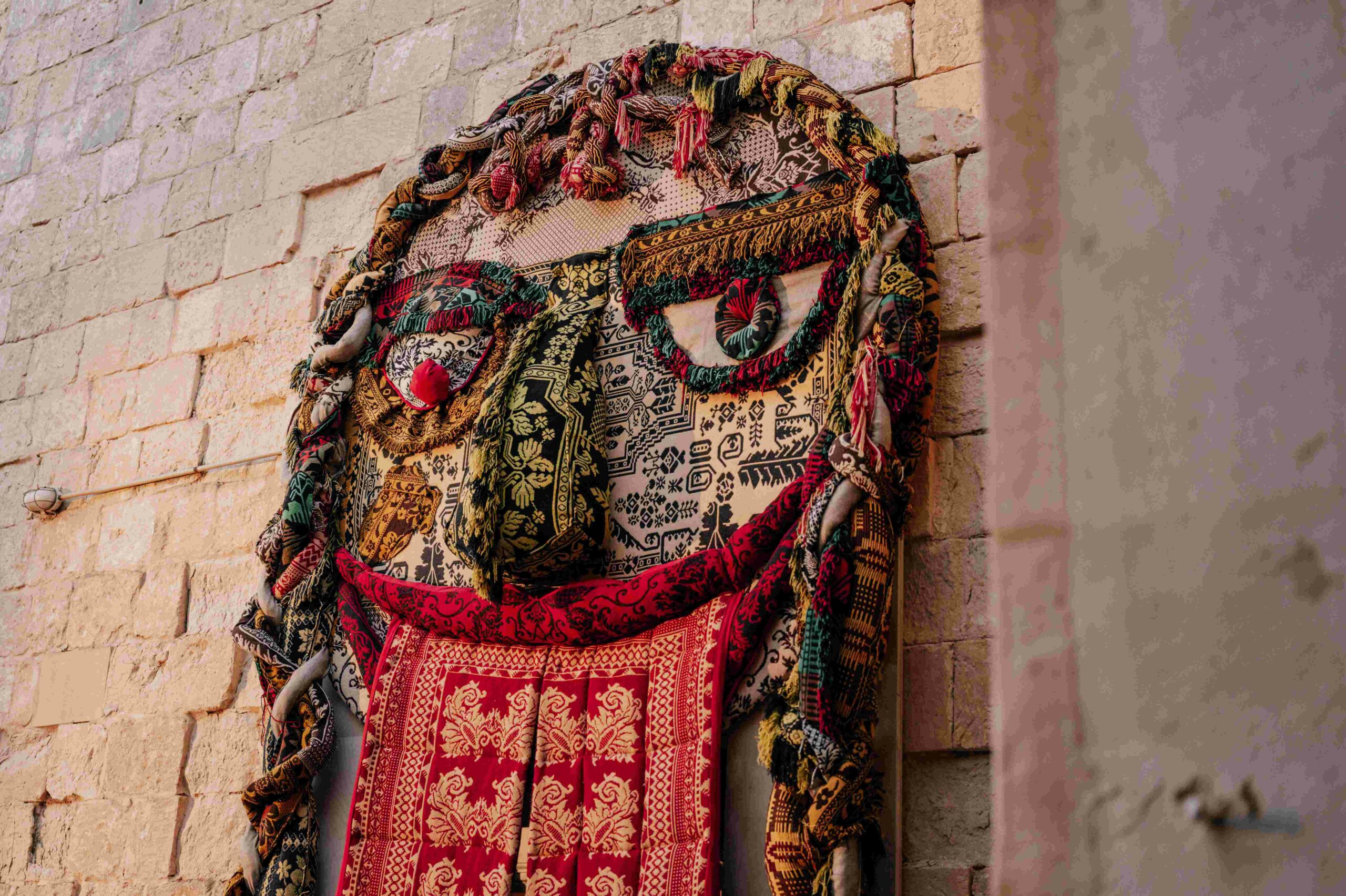
collage, wool rugs from the Polish Podlasie region: jacquards, double-warp and “radziuszka” fabrics
240 x 440 x 130 cm
The title of the work is a fragment of wishes spoken by groups of carollers known as the Draby – men dressed in full-body straw masks. They visit households on New Year’s Eve or New Year’s Day, mainly in the southern borderlands of Poland, fulfilling a magical function and bringing good fortune to the household. The etymology of this tradition reaches back to pagan times.
Proszczuk’s mask is a play on materials, patterns, and memories. The artwork is made from woollen bedspreads originating from the Podlasie region and connected to the artist’s childhood.
Masks are common in both African and Slavic cultures. They remind us of the merging of worlds, of transitions between the living and the dead, and of the need for kindness toward the deities who watch over us. Suspended above the doors of the exhibition pavilion, the mask becomes a kind of portal, not only between the worlds of the living and the dead, but also between cultures. It serves as a link between Poland and Ghana. It also references Malta, where the tradition of carnival with medieval roots remains alive.
Eliza Proszczuk (b. 1980) is a Polish visual artist, PhD in Fine Arts, academic lecturer, and researcher. She creates textiles, spatial objects, and collages, treating art as a tool for social change and a space of emancipation. In her practice, she explores themes of memory, inheritance, and women’s herstory, combining artistic activity with research and social engagement.
Related news